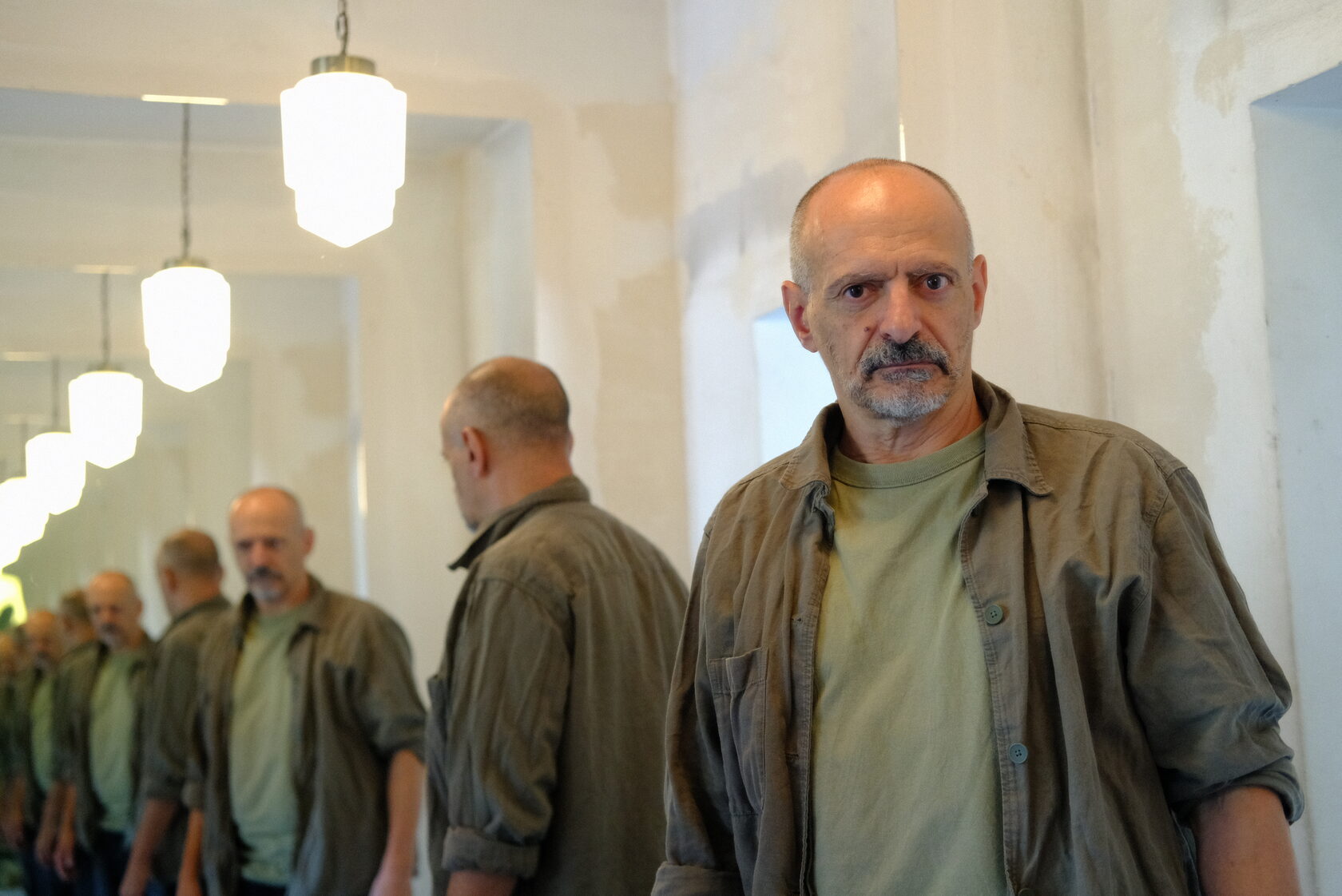
“I have been totally involved in the darkest aspects of humanity,” says Antoine d’Agata, reflecting on his incredible photography career. The 64-year-old artist is in Yerevan for a workshop on photography within the framework of Golden Apricot. The Daily sat down with the man who is known for his unflinching photowork.
Antoine d’Agata was shaped by his native drug- and violence-ridled Marseille, a vagabond life since teenage years, prolonged travels through dangerous corners of the planet, and studies at the “International Center of Photography”, along with Nan Goldin and Larry Clark. After 30 years of living and photographing around the world, Agata’s work is known for its provocative nature and uncompromising pursuit of the naked truth. At the same time, his photography is marked by a unique ability to share raw emotion and pain with his subjects — and to weave his own invisible presence behind the lens into the story being told. This rare combination is what makes him one of the greatest photographers in history. These days, Agata carries out the mission of a teacher, having conducted over 170 masterclasses to date, which he describes as a “primordial practice.” And although his style is based on a unique life experience rooted in a subjective gaze, he almost never speaks about himself when approached for advice. Instead, he stands “at the service of the young people, trying to generate and perfect their own direction.”
Today, Agata sees his rich career as a specific exploration of two opposing forms of violence that are “in constant struggle with each other. One side of my work is deeply personal because I photograph the part of the world I chose to live in. I capture images of people who resist social and economic violence by sharing with them all possible means of resistance.” This is a reflection of what he calls “night work” — the capturing of complex ways of surviving, including all types of drugs, criminal or sex work. These rough, blurred, and very emotional series, such as Stigma (2004) — an investigation into the less glamorous side of prostitution — brought him worldwide fame and a membership in “Magnum Photos” agency. In recent years, he ventured into dangerous territories marked by full-scale wars and genocides — both their long-silent remnants and their fresh scars. “It’s about looking at the world and trying to make sense of it. I'm not a specialist and I'm not a war photographer, but I follow conflicts, I observe refugees, and I go where I believe it's my duty and responsibility to go.” Agata has photographed in Israel, Palestine, Laos, Vietnam, Iraq, and recently, in Ukraine, to just name a few.
A recent astonishing creative collaboration took place with French historian and writer Jonathan Littell (of The Kindly Ones fame) on the book An Inconvenient Place. In Ukraine, Agata faced new challenges — for example, photographing Babyn Yar, the site of mass executions during World War II. There, in the present day, he encountered a productive challenge for any photographer: “To struggle with the problematic that belongs to the past, where it seems almost no traces are left. But just by scratching the surface, you find the landscape itself still wears the traces of this in the present time.” Agata discovered this lingering curse of the Kyiv region after photographing de-occupied Bucha, where he captured the bodies of dead Russian soldiers — converting them into negatives, because only in that form, “expressions came back on the faces.”
When photographing extreme subjects, Agata does not concern himself with ethical questions, but that does not mean he lacks empathy. Decades of shooting in search of the right, but consciously imperfect frame, while composing collages aimed at amplifying pain and testimony, speak about him as an exceptionally sensitive artist with a courageous philosophical approach. “One of the responsibilities I have as a photographer is to invent new imagery that challenges the viewer”, he concludes․
Sonya Vseliubska
Photo by Mane Hovhannisyan
Antoine d’Agata was shaped by his native drug- and violence-ridled Marseille, a vagabond life since teenage years, prolonged travels through dangerous corners of the planet, and studies at the “International Center of Photography”, along with Nan Goldin and Larry Clark. After 30 years of living and photographing around the world, Agata’s work is known for its provocative nature and uncompromising pursuit of the naked truth. At the same time, his photography is marked by a unique ability to share raw emotion and pain with his subjects — and to weave his own invisible presence behind the lens into the story being told. This rare combination is what makes him one of the greatest photographers in history. These days, Agata carries out the mission of a teacher, having conducted over 170 masterclasses to date, which he describes as a “primordial practice.” And although his style is based on a unique life experience rooted in a subjective gaze, he almost never speaks about himself when approached for advice. Instead, he stands “at the service of the young people, trying to generate and perfect their own direction.”
Today, Agata sees his rich career as a specific exploration of two opposing forms of violence that are “in constant struggle with each other. One side of my work is deeply personal because I photograph the part of the world I chose to live in. I capture images of people who resist social and economic violence by sharing with them all possible means of resistance.” This is a reflection of what he calls “night work” — the capturing of complex ways of surviving, including all types of drugs, criminal or sex work. These rough, blurred, and very emotional series, such as Stigma (2004) — an investigation into the less glamorous side of prostitution — brought him worldwide fame and a membership in “Magnum Photos” agency. In recent years, he ventured into dangerous territories marked by full-scale wars and genocides — both their long-silent remnants and their fresh scars. “It’s about looking at the world and trying to make sense of it. I'm not a specialist and I'm not a war photographer, but I follow conflicts, I observe refugees, and I go where I believe it's my duty and responsibility to go.” Agata has photographed in Israel, Palestine, Laos, Vietnam, Iraq, and recently, in Ukraine, to just name a few.
A recent astonishing creative collaboration took place with French historian and writer Jonathan Littell (of The Kindly Ones fame) on the book An Inconvenient Place. In Ukraine, Agata faced new challenges — for example, photographing Babyn Yar, the site of mass executions during World War II. There, in the present day, he encountered a productive challenge for any photographer: “To struggle with the problematic that belongs to the past, where it seems almost no traces are left. But just by scratching the surface, you find the landscape itself still wears the traces of this in the present time.” Agata discovered this lingering curse of the Kyiv region after photographing de-occupied Bucha, where he captured the bodies of dead Russian soldiers — converting them into negatives, because only in that form, “expressions came back on the faces.”
When photographing extreme subjects, Agata does not concern himself with ethical questions, but that does not mean he lacks empathy. Decades of shooting in search of the right, but consciously imperfect frame, while composing collages aimed at amplifying pain and testimony, speak about him as an exceptionally sensitive artist with a courageous philosophical approach. “One of the responsibilities I have as a photographer is to invent new imagery that challenges the viewer”, he concludes․
Sonya Vseliubska
Photo by Mane Hovhannisyan