Many of the world’s red carpets are doomed to gather dust until the end of time. But the carpets of Golden Apricot — both this year’s and last — might just outlast us all. After all, these aren’t just carpets. They are works of art. “In recent decades, I haven’t seen another instance where, within the framework of a film festival, two consecutive opening ceremonies featured new carpets conceived with contemporary concepts,” says curator Nairi Khatchadourian. “I think this brings a very beautiful and meaningful shift to the ritual.”
It was Khatchadourian and the AHA Collective, which she leads, who curated the 2024 collection of carpets designed by artist Davit Kochunts (also the author of this year’s GAIFF poster), titled Point of Reference, which featured vein-like dark-red maps of depopulated Armenian towns and villages in Artsakh, guiding local and international guests from the entrance of the Karen Demirchyan Sports and Concerts Complex toward the ceremony hall.
This year’s collection, titled Warp and Variations, was created by the co-founders of the Paris-based Normal Studio — French-Armenian Jean-François Dinkjian and French Eloi Chafaï — both of whom have been frequent visitors to Armenia in recent years as the designers of the newly opened TUMO Center in Kapan. “Last year’s context was very different, much more personal for both Davit Kochunts and me,” Khatchadourian explains. “Davit was a veteran of the 2020 war, and in 2023, after the forced displacement of Artsakh Armenians, I was at the border helping on the ground. Jean-François and Eloi, as French artists, approached this year’s project more from the foundations of carpet-making. And what is that foundation? The warp.” In traditional carpet weaving, the warp — the vertical threads forming the backbone of the carpet — gradually disappears beneath the weft. The artists decided to “explore that hidden structure, crafting a visual journey for guests that would evolve dynamically from beginning to end. Vertical lines were divided into subdivisions, color tones were layered and blended, and the result moved closer to optical art in its design.”
Each stage of creating the eight carpets — totaling 16 meters in length — from sourcing local Armenian wool, to natural dyeing, to hand-weaving, was executed by local artisans in collaboration with the Armenian Wool Project, Woolway Studio, and displaced mother-daughter duo Milena and Galina Ordyants from Artsakh. The project was supported by the French Embassy in Armenia, the French Institute, and CCIFA. Following Golden Apricot, the collection will be exhibited for several months at AHA Collective’s gallery.
This marked the French designers’ first experience working with soft materials. Until now, they had primarily worked with wood, metal, concrete, glass, and clay and especially in furniture design. Textile remained unexplored territory. Their concept was inspired not only by the physical structure and function of the warp, but also by its more abstract qualities. “When women weave,” says Khatchadourian, “if someone were to visit their workshop, it’s like listening to a string orchestra. The warp itself is like a set of strings — cotton strings. This musical dimension within carpet-making hasn’t really been explored yet.”
The project also sheds light on a broader issue: in the entire history of the independent Armenia, you can count on one hand examples of artists attempting to revalue and reinterpret the Armenian carpet. “The culture of carpet weaving got stuck in a loop” laments Khatchadourian. “Too often, we distort a one-of-a-kind carpet woven by, for example, a woman in Khndzoresk a hundred years ago (even though it belongs to a particular school, it’s still unique), by mechanically reproducing it today. And on top of that, modern reproductions often use synthetic dyes — meaning they lack the vivid, vibrant, natural palette of historical pieces.” In other words, while the Armenian carpet is still widely revered, it’s mostly seen as something from the past — a legacy to preserve, not a living, breathing field that constantly rediscovers itself.
This new festival tradition established by Golden Apricot and the curatorial practice AHA Collective — and which they promise to continue developing in the coming years — may well lay the groundwork for a renewed interest in contemporary Armenian carpet weaving. “We have the talent,” Nairi says with conviction. Last year’s Point of Reference collection was already exhibited in France, at the 13th Saint-Étienne International Design Biennale. One of the carpets from that series was presented to American director Alexander Payne, jury president of GAIFF 2024, at the festival’s closing ceremony.
But Khatchadourian envisions something grander: “If, say, the president of Iran comes to Armenia, or the Armenian prime minister visits France, a modern Armenian carpet could be the gift offered by the Republic of Armenia. It could become part of our cultural diplomacy — an instrument of soft power.” All that remains is for the message to reach its audience. “Both the festival and the state need to understand that a major innovation is happening here. Come and stand by it!”
Artur Vardikyan
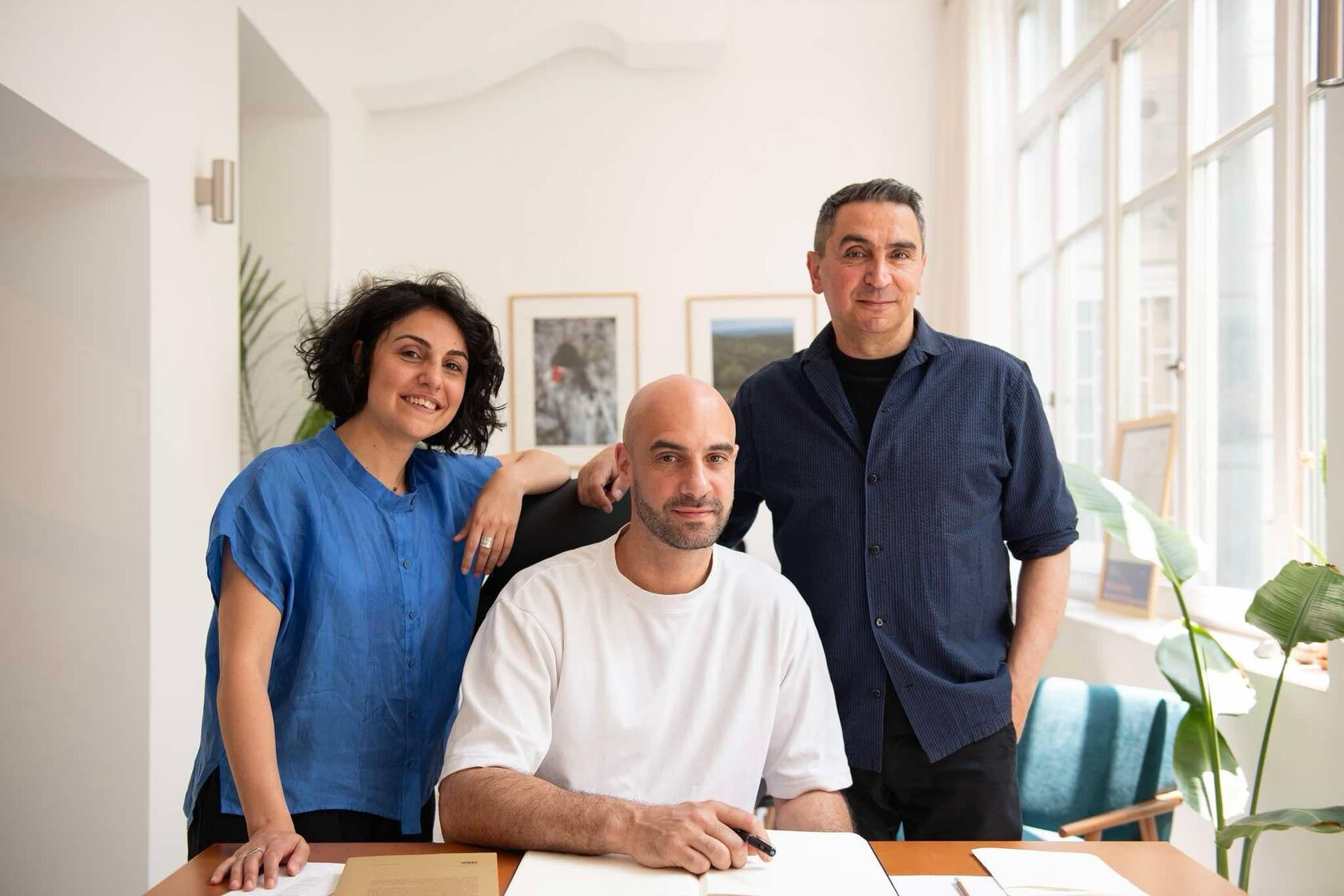
In the photo: Nairi Khatchadourian, Jean-François Dinkjian and Eloi Chafaï
Photo by Piruza Khalapyan
It was Khatchadourian and the AHA Collective, which she leads, who curated the 2024 collection of carpets designed by artist Davit Kochunts (also the author of this year’s GAIFF poster), titled Point of Reference, which featured vein-like dark-red maps of depopulated Armenian towns and villages in Artsakh, guiding local and international guests from the entrance of the Karen Demirchyan Sports and Concerts Complex toward the ceremony hall.
This year’s collection, titled Warp and Variations, was created by the co-founders of the Paris-based Normal Studio — French-Armenian Jean-François Dinkjian and French Eloi Chafaï — both of whom have been frequent visitors to Armenia in recent years as the designers of the newly opened TUMO Center in Kapan. “Last year’s context was very different, much more personal for both Davit Kochunts and me,” Khatchadourian explains. “Davit was a veteran of the 2020 war, and in 2023, after the forced displacement of Artsakh Armenians, I was at the border helping on the ground. Jean-François and Eloi, as French artists, approached this year’s project more from the foundations of carpet-making. And what is that foundation? The warp.” In traditional carpet weaving, the warp — the vertical threads forming the backbone of the carpet — gradually disappears beneath the weft. The artists decided to “explore that hidden structure, crafting a visual journey for guests that would evolve dynamically from beginning to end. Vertical lines were divided into subdivisions, color tones were layered and blended, and the result moved closer to optical art in its design.”
Each stage of creating the eight carpets — totaling 16 meters in length — from sourcing local Armenian wool, to natural dyeing, to hand-weaving, was executed by local artisans in collaboration with the Armenian Wool Project, Woolway Studio, and displaced mother-daughter duo Milena and Galina Ordyants from Artsakh. The project was supported by the French Embassy in Armenia, the French Institute, and CCIFA. Following Golden Apricot, the collection will be exhibited for several months at AHA Collective’s gallery.
This marked the French designers’ first experience working with soft materials. Until now, they had primarily worked with wood, metal, concrete, glass, and clay and especially in furniture design. Textile remained unexplored territory. Their concept was inspired not only by the physical structure and function of the warp, but also by its more abstract qualities. “When women weave,” says Khatchadourian, “if someone were to visit their workshop, it’s like listening to a string orchestra. The warp itself is like a set of strings — cotton strings. This musical dimension within carpet-making hasn’t really been explored yet.”
The project also sheds light on a broader issue: in the entire history of the independent Armenia, you can count on one hand examples of artists attempting to revalue and reinterpret the Armenian carpet. “The culture of carpet weaving got stuck in a loop” laments Khatchadourian. “Too often, we distort a one-of-a-kind carpet woven by, for example, a woman in Khndzoresk a hundred years ago (even though it belongs to a particular school, it’s still unique), by mechanically reproducing it today. And on top of that, modern reproductions often use synthetic dyes — meaning they lack the vivid, vibrant, natural palette of historical pieces.” In other words, while the Armenian carpet is still widely revered, it’s mostly seen as something from the past — a legacy to preserve, not a living, breathing field that constantly rediscovers itself.
This new festival tradition established by Golden Apricot and the curatorial practice AHA Collective — and which they promise to continue developing in the coming years — may well lay the groundwork for a renewed interest in contemporary Armenian carpet weaving. “We have the talent,” Nairi says with conviction. Last year’s Point of Reference collection was already exhibited in France, at the 13th Saint-Étienne International Design Biennale. One of the carpets from that series was presented to American director Alexander Payne, jury president of GAIFF 2024, at the festival’s closing ceremony.
But Khatchadourian envisions something grander: “If, say, the president of Iran comes to Armenia, or the Armenian prime minister visits France, a modern Armenian carpet could be the gift offered by the Republic of Armenia. It could become part of our cultural diplomacy — an instrument of soft power.” All that remains is for the message to reach its audience. “Both the festival and the state need to understand that a major innovation is happening here. Come and stand by it!”
Artur Vardikyan
In the photo: Nairi Khatchadourian, Jean-François Dinkjian and Eloi Chafaï
Photo by Piruza Khalapyan